
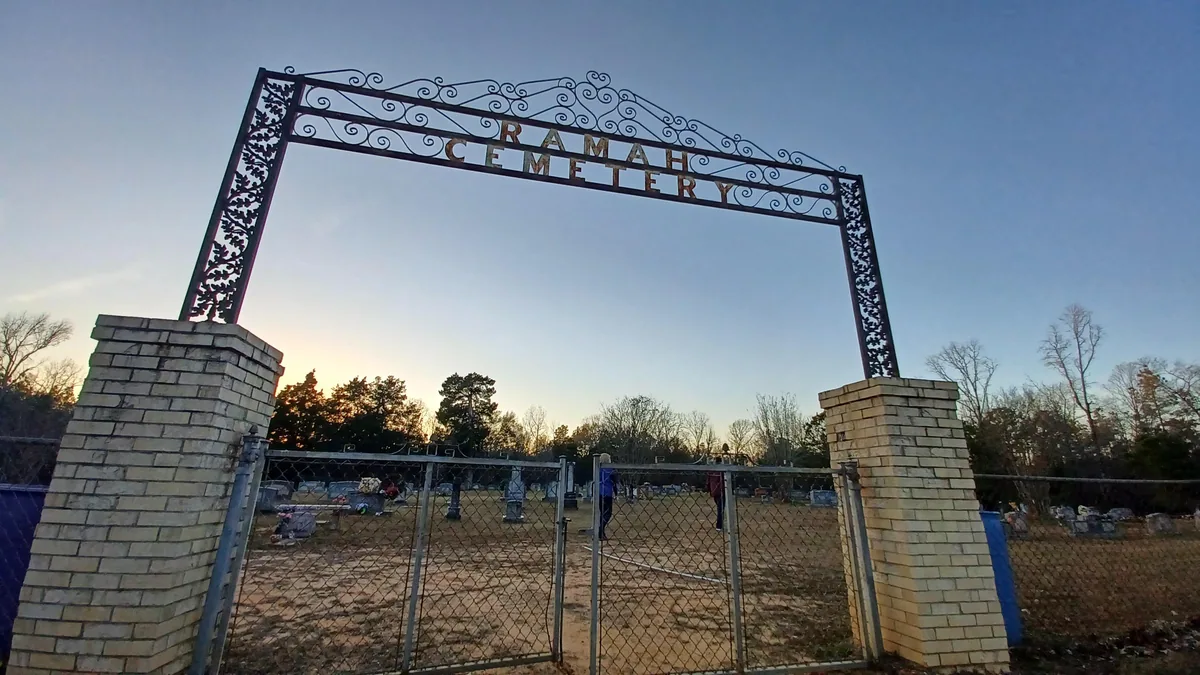
Ramah Cemetery sits on Highway 153 just south of Ashland, a mile off the road that runs toward Coushatta. In February 1869 Madison Mobley and his wife Sarah sold the six-hundred-acre Mobley Place to George W. Luckey. The deed, filed that May, carved out the lot where Ramah Church already stood and kept it for the church and the cemetery. The sale did not create the churchyard. It only wrote down what was already there. Barron graves in these rows go back to 1864, a year of the war and five years before the clerks recorded the reservation. The name on the church is biblical, a high place, and the cemetery kept it after the village around it took another name.
Ashland itself is younger than the cemetery. The railroad came through in 1899. Lots were sold and the village named in 1901. By then this churchyard on 153 was already taking the families who farmed this end of the parish. It is the larger of Ashland’s two cemeteries, about 350 marked graves, and it remains a community cemetery rather than a plot closed to one line. The smaller family yard is Hathorn Cemetery, west toward Coushatta. This one is the town’s.
The stones repeat the names that built the settlement and married across it: Barron, Pullig, Lucky, Coffey, Ayres, Allen, Abel, Ard, Lavespere, Womack. Joseph Pullig kept the general store near the new post office when Ashland was still a turntable and a platform for cotton. Pullig daughters married Barrons. Patrick Coffey ran the volunteer work on the Chapel of Taps at Hathorn Cemetery and died five months before that chapel was dedicated in 1968. He is buried here. Judge H. Welborn Ayres, born in Ashland, wrote the town’s history for the Ramah Cemetery Association in 1979. Clovis Pullig taught for thirty-five years, sat as alderman, served as mayor, and was brought here from Ashland Baptist in 2013. Veterans from the world wars share the later rows with infants whose dates stop on the day they start.
The cemetery is still in use. Come in daylight. Stay on the paths that are already cut.