
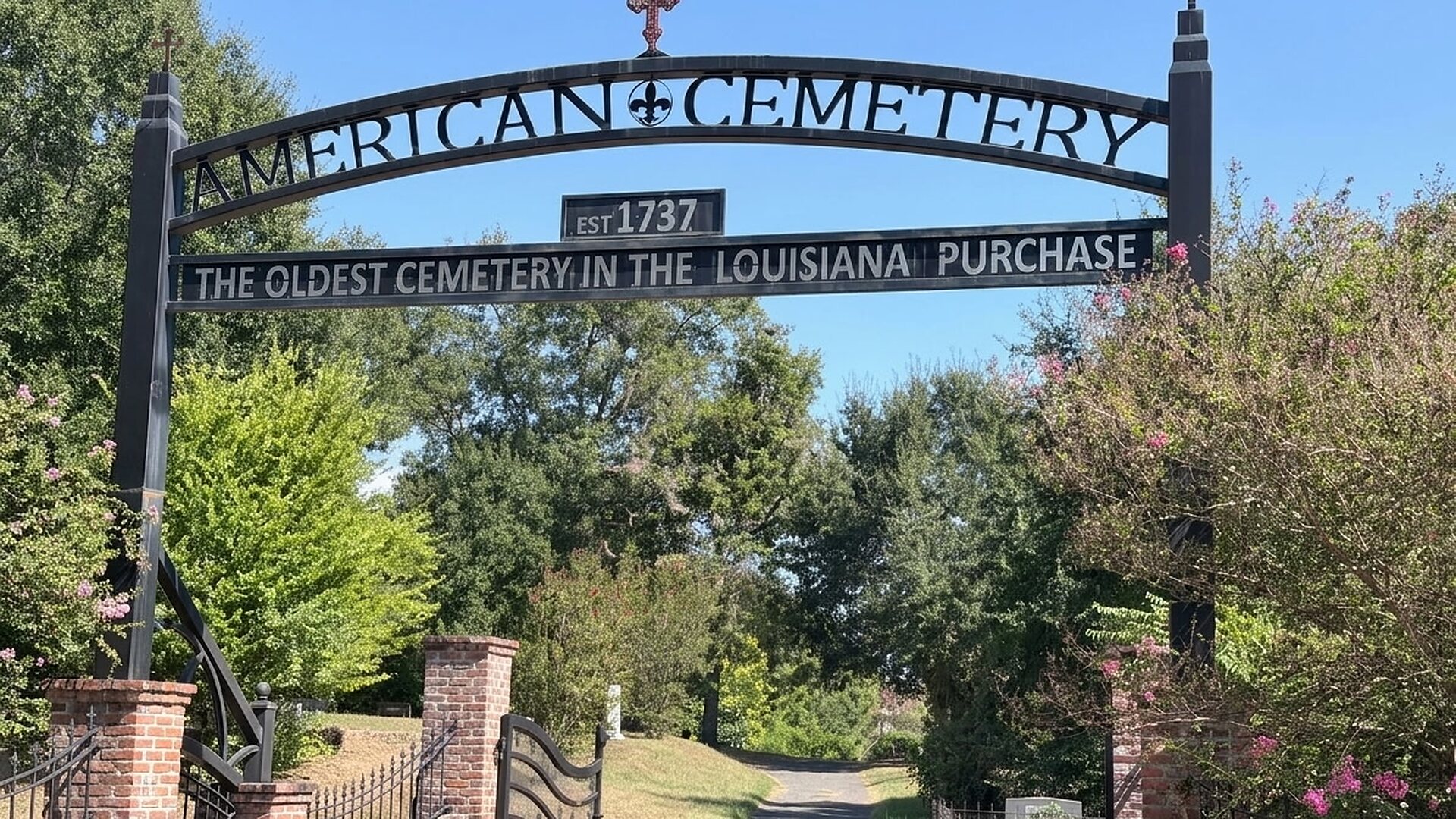
American Cemetery sits on the hill where the French rebuilt Fort St. Jean Baptiste after the 1731 Natchez attack. The post needed a parish cemetery beside the fort and church, and burials here are thought to have begun around 1737. Louis Juchereau de St. Denis, who founded Natchitoches in 1714, is believed to have been laid here in 1744; no stone marks the spot. The oldest marker that survives is the 1797 iron cross of Dame Marie Ann D'Artigaux, a French noblewoman sent to the colony after banishment from court. The place was first called the Catholic Cemetery. After the Louisiana Purchase, Protestants and other newcomers were interred here as well, and the name became American Cemetery.
The stones carry the families that built Cane River country: Prud'homme, Lambre, Cloutier, Rouquier, Buard, DeBlieux, Sompayrac. Jean Pierre Emmanuel Prud'homme, who planted the first cotton crop in north Louisiana and sat in the 1812 constitutional convention, is here. So is Dr. John Sibley, the Massachusetts physician Thomas Jefferson made Indian agent on this frontier. John Gideon Lewis Sr., who founded the Natchitoches Prince Hall Masons, has the only mausoleum on the hill. Mayor Theodore Edward Poleman, shot in 1922 over a street-grading fight with a mineral-water dealer, is here too. Soldiers from the Red River Campaign through Vietnam share the rows. Early graves were often stacked three and four deep, and many of the first markers were iron crosses forged by local blacksmiths.
In August 1988 the American Cemetery Association leased the place to Tri-Star Pictures for one dollar so Herbert Ross could film Shelby’s funeral for Steel Magnolias. The check was never cashed. A marker now stands where Sally Field, Dolly Parton, Olympia Dukakis, Shirley MacLaine, and Daryl Hannah played the scene. The story is Natchitoches-born Robert Harling’s; Shelby is his sister, Laura Susan Harling Robinson. She is not buried here. The public park named after her is a short walk from the cemetery gate.
By 1900 the cemetery had gone to weeds. In 1904, a group of local residents formed the American Cemetery Association and have kept it, with the city, ever since. It is still an active cemetery. Walk it in daylight. Be respectful of the locals.